
Related

EU Omnibus Packages Part 5: Omnibus V – Simplifying EU Defense Regulation
EU Omnibus Packages Part 4: Omnibus IV — Product Regulation, Simplification, and Compliance

Athletes Disqualified at 2026 Winter Olympics Over PFAS

EU Omnibus Packages Part 3: Simplifying EU Agricultural Regulation
In today's data-driven world, Artificial Intelligence (AI) isn't just on the map - it's the fast lane. From mining critical insights and tracking regulatory shifts to forecasting risk, monitoring employee health and safety metrics, and streamlining reporting, AI is steering the future of EHS, sustainability, and compliance. But as professionals take the wheel, what roadblocks and green lights lie ahead on the journey? This series of articles will help you navigate the future of AI in EHS.
Popular topics of conversation for environment, health, and safety (EHS) professionals include needing more resources and doing more with fewer resources. These days, one of those longed-for resources might be the use of generative AI (Gen AI), which creates new, original content based on what it has learned from existing data. When fed accurate data and given clear prompts, it is able to adapt to your changing workplace, workflows, and business challenges.
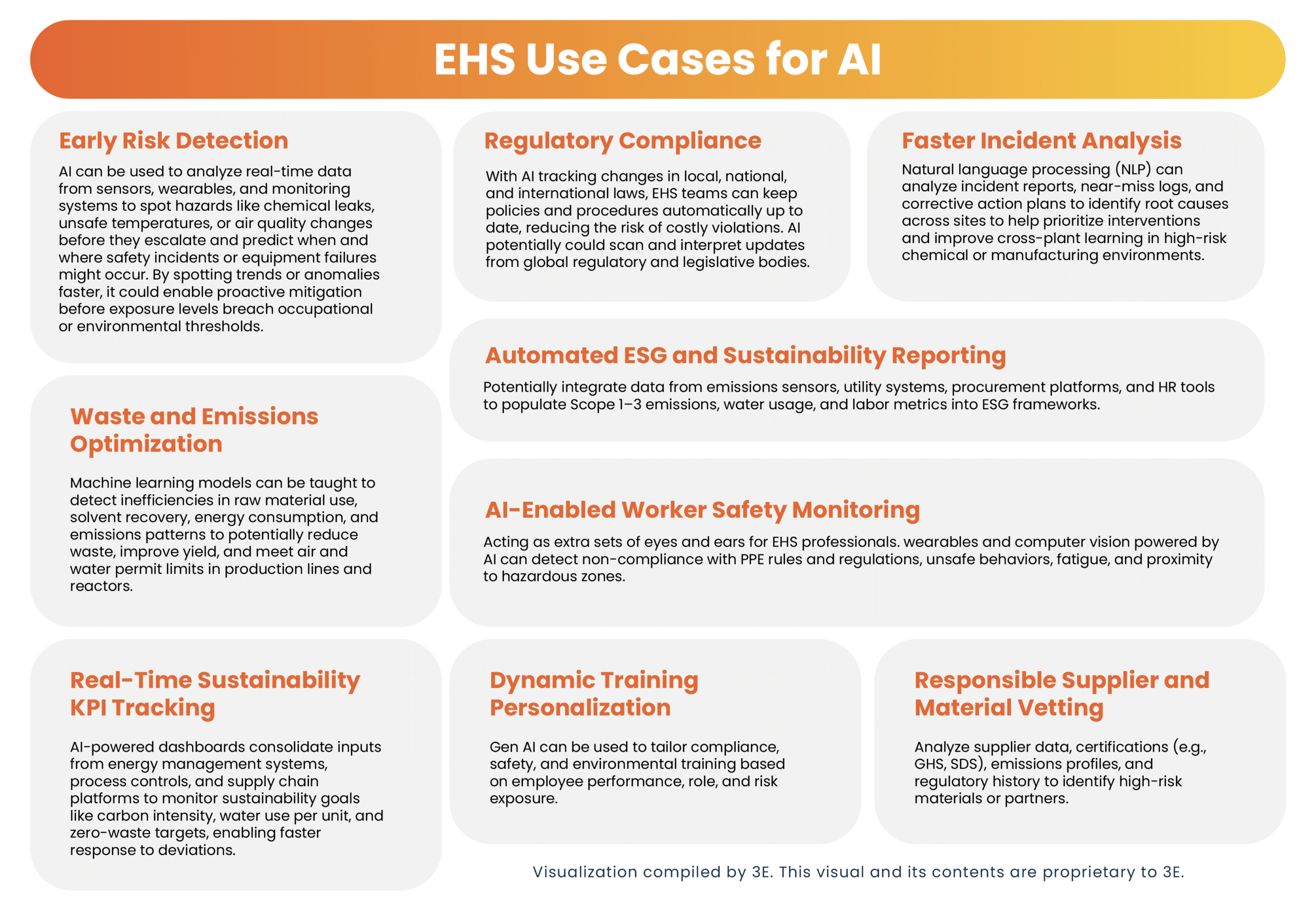
Once they've acknowledged the challenges to adopting AI and asked themselves the right questions, EHS professionals are learning where Gen AI can fill some of their resource gaps, helping them move from reactive problem-solving to proactive prevention and risk management, all while saving time, improving compliance, and boosting workplace safety.
“Today, AI's sweet spots are SDS/chemical parsing, regulatory scanning, incident patterning, and vision-based safety - turning noise into recommended actions,” said Alan Johnson, managing director, Chemical Management & Workplace Safety, 3E. “In two to five years, EHS teams will rely on live risk copilots and agentic workflows that draft permits, trigger MOC/CAPA, and assemble auditable evidence.”
In other words, he adds: “Human oversight, AI execution.”
Why AI Fails to Launch at Some Companies
A new McKinsey & Co survey found that more than three-quarters of respondents said that their organizations use AI in at least one business function, with some 21% of respondents reporting generative AI was used by their organizations to redesign workflows. EHS professionals are seeing this is a way to go “all in” on AI.
Nicole M. Radziwill, PhD, MBA, is co-founder/CTAIO of Team-X AI and board advisor at IQ Labs, Inc., where she helps senior and executive teams manage AI implementation, risk, and impact, empowering high-growth startups and Fortune 1000 clients to leverage AI and data through power-sensitive data/AI strategies.
“We implement AI to get more info, better info, deeper info,” Radziwill told 3E. “AI can get us that deeper information, but there are costs: potentially reduced accuracy or precision, higher development costs, and higher maintenance costs.”
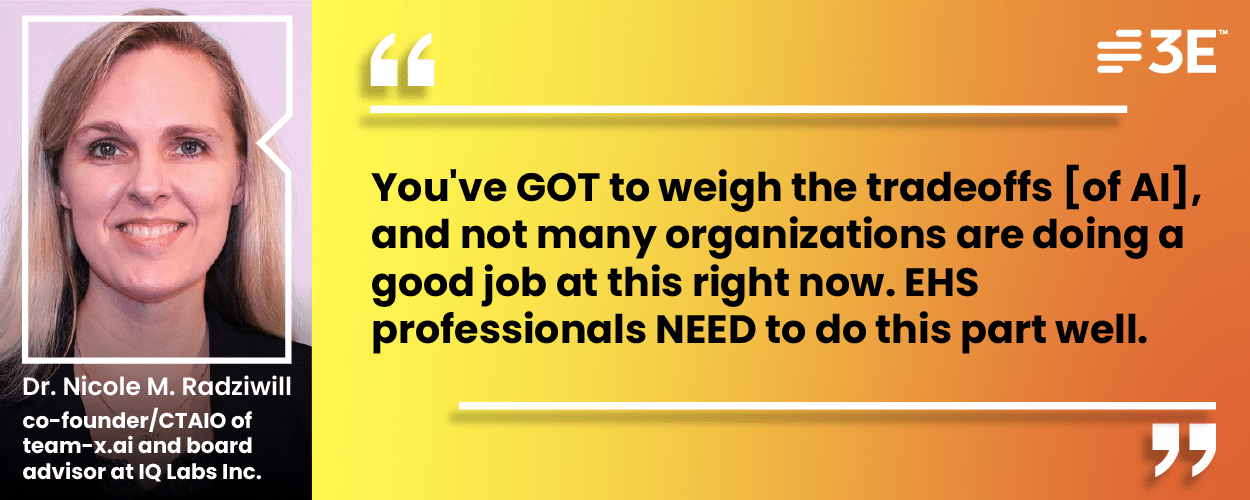
She pointed out that AI works for some tasks, while more traditional methods are best for others, and all have their challenges. “Generative AI excels at creative problem-solving, natural language processing, and handling ambiguous queries, but can hallucinate [the AI model produces answers that sound authoritative but are factually wrong] and lacks precision,” said Radziwill. “Traditional machine learning offers reliable, measurable results for structured data but requires extensive up-front engineering. Traditional programming/scripting provides deterministic, debuggable solutions with full control but demands that you understand and implement logic manually and tends to die when faced with unexpected data or new situations.”
Radziwill cautions that with the sizable investment in both time and resources, it's important that organizations not set themselves up for failure with AI.
“The first time I deployed AI for work was in 1998. We built an expert system to help us diagnose the quality of incoming observations after there wasn’t enough time or labor available to manually inspect them all,” Radziwill told 3E. “So, in the three decades since, I've probably deployed or managed or advised hundreds of projects that have incorporated AI for EHSQ and beyond. In my 2020 book, I looked at a few hundred implementations of AI and other emerging tech to try and figure out why 70-90% of digital transformations fail.”
The C-I-A model (connectedness/intelligence/automation) for AI is a strategic framework in which connected Intelligence gathers and unifies data, AI analyzes that data for insights and decision-making, and automation uses those insights to execute actions and streamline processes, often integrating across various systems to create intelligent, responsive, and efficient operations. This allows AI to transform raw, connected data into automated, strategic workflows that improve productivity and drive business outcomes … if you ask the right questions.
Radziwill said she realized that many people were not asking a few important questions about connectedness, namely: Which person or system needs the info? When do they need it? Why do they need it? What goal are they trying to achieve with it?
“The solution has to support the improvement goal, or it's not a solution,” Radziwill pointed out.
Intelligence comes into the picture because you need info where there is none, she said, or you need more information or better information than you have now. Automation is getting that information to the person or system who needs it: on time, faster, and more frequently.
Leading EHS with AI
At one point, Vibrantz Technologies, which offers specialty chemicals and materials solutions, had some 63 recordable injuries in a year across its sites, a number Global Vice President of Environmental, Health & Safety Adam Bates calls “a dismal performance.” In 2024, the company experienced a 51% improvement. At the time of our interview in 2025, the number of recordable injuries across all sites was less than 10% of that earlier “dismal” year.
“I don't equate that to anything 'Adam-related,'” he noted. “It's about putting in new systems and updating the playbook and putting the right people in the right roles. Like any sport, no matter what's in your playbook, if you don't have the right systems in place and the right people running the plays, you can't be successful.”
In 2025 and looking ahead to 2026, Bates says many of those EHS systems he's fine-tuning are or will be AI-related or AI-enabled. “It's how do we do more with less. We ask ourselves: 'How can we use AI to push the envelope?'”
The more he uses it, he said, the more comfortable he gets with it and the more uses he finds for it. He equates traditional EHS program management - which utilizes spreadsheets and programming and is reactionary rather than predictive - to the use of a traditional analog flip phone in comparison to today's smart phones.
“When we started transitioning from those flip phones to iPhones, there was a lack of understanding about what came next,” Bates remembered. “But look how we use iPhones now and the technology and apps and everything else they bring us today! If you were still walking around with that traditional flip phone, you would not even be able to imagine what [a smartphone] can do.”
The same is true of AI, said Bates. Until you use it, you can't understand the power and advancements it can bring to your business in general and EHS in particular. At most organizations, he added, the enterprise-wide adoption of AI is outside of the traditional EHS professional's lane but that shouldn't stop them from contributing to those discussions.
“In probably two to three years, AI will be a part of everything we do, so how do we as EHS professionals use it? That's what I'm exploring. I want to be a profession-changing leader for the next generation coming in, and I want to be part of how we embrace AI in our core EHS practice and integrate AI into other parts of the business.”
He said his company is using AI to manage mechanical reliability function programs, explore ways to strengthen the supply chain, and to analyze incident data, all of which can help make the business more resilient and less likely to experience unplanned downtime.
“We have all this data,” said Bates. “We no longer need to [manually] create charts, which used to take so much time and effort. Now, we upload all the data into our AI tool and say, 'Create a chart for root cause analysis or primary actions,' and it does it in seconds.” That information can then be included in reports, communications, or presentations and offer a quick visual overview of the information being shared, rather than requiring thousands of words to describe the same thing. “We're trying to get away from long emails that had everything explained in great detail. I want to communicate less, but I want my communications to be more valued,” admitted Bates.
His organization also uses AI for incident reviews. The process includes a flow chart of the incident, communication about the incident within 24 hours, and a follow-up communication at 36 hours. Within seven days, a full report is generated that is sent to a group of senior leaders.
“I take the legwork the site does on the root cause analysis of the incident, and I drop it into our AI and check to see if we're missing something [or has the incident been fully investigated]?” Bates then uses that information as part of the report that is generated for senior leaders.
He said they currently are developing an AI incident management module that will enable Bates and his team to manage an incident's full life cycle starting with the root cause and ending with assigning preventative actions to ensure the incident does not repeat.
“To me, that's the space that we're pushing toward: How do we utilize AI so the system gives us at least the start of the root cause analysis and corrective actions?” said Bates. Sooner than later, their AI use will allow them to be predictive and avoid incidents, rather than just helping them respond and document after the fact, he said.
Advice from Experts
While both Radziwill and Bates embrace AI and are constantly exploring ways to make it more useful for the EHS function, Radziwill warned that there are trade-offs for any solutions pursued by EHS professionals, whether it is AI, machine learning, or traditional programming/scripting. In other words, don't try to fix problems you don't have or that you don't need AI to solve.
“Generative AI excels at creative problem-solving, natural language processing, and handling ambiguous queries,” she said, adding, “But way too often, in the gold rush to 'leverage the value of AI,' people conflate automation and intelligence.”
Radziwill said she recently spoke with someone who built an elaborate mechanism to use MCP (model context protocol) technology for AI agents to retrieve information and recreate reports that clients receive daily. It wasn't working, and he was running out of time to provide it to the client by the deadline set for the project.
She asked him if the client was currently getting the information they needed, and he said yes. She asked, “Do they need more info/better info/info where none exists?' and he said no. Finally, she asked him if he needed to get that information to them faster or more frequently and again, he said no.
“So basically, he had just spent two weeks cooking up elaborate AI-driven tech [for a problem that already had been solved by existing traditional programming] and had zero need at all for a complex system good at handling fuzzy or novel scenarios. A LOT of people are falling into the same trap,” Radziwill emphasized.
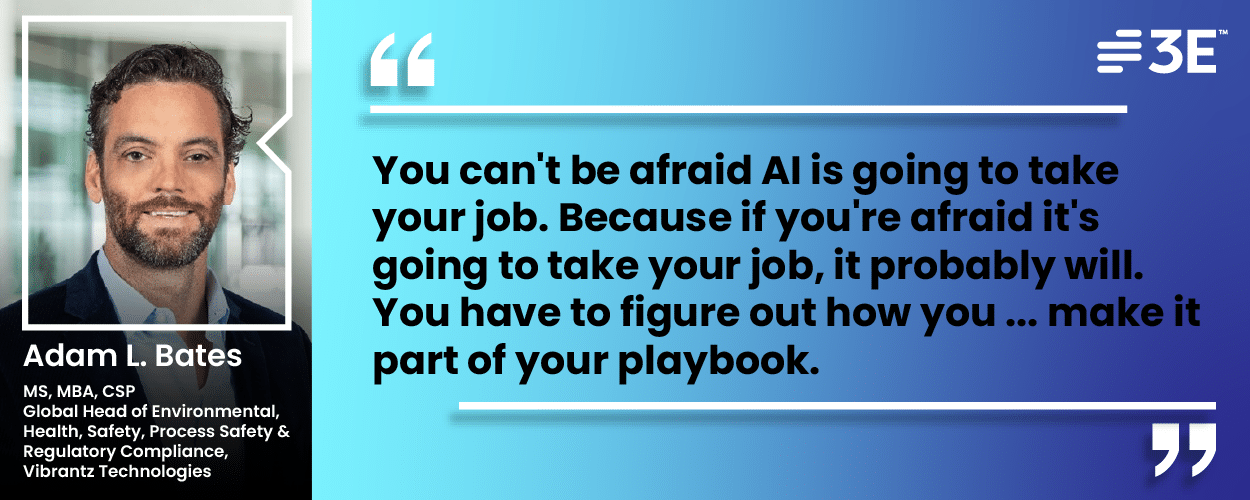
Some EHS professionals have not been early adopters of AI. Bates offered this important piece of advice for them: Don't be afraid of AI. “You can't be afraid it's going to take your job. Because if you're afraid it's going to take your job, it probably will. You have to figure out how you use it to enhance and increase the visibility, the effectiveness of your job and make it part of your playbook.”
As for Alan Johnson, his advice neatly dovetails with that of both Radziwill and Bates: “Start small: pick two data-rich use cases, set clear metrics, and keep humans in the loop. For the bold, build a governed data layer, adopt an AI assurance framework, and scale via agentic workflows. Measure impact relentlessly - speed, quality, and risk reduction - and no pilots for pilots' sake.”


Insights straight to your inbox
Sign Up NowIndustry Editor
Sandy Smith
Sandy Smith is an award-winning newspaper reporter and business-to-business journalist who has spent 20+ years researching and writing about EHS, regulatory compliance, and risk management and networking with EHS professionals. She is passionate about helping to build and maintain safe workplaces and promote workplace cultures that support EHS, and has been interviewed about workplace safety and risk management by The Wall Street Journal, CNN, and USA Today.

Related Resources
News
EU Omnibus Packages Part 5: Omnibus V – Simplifying EU Defense Regulation
News
EU Omnibus Packages Part 4: Omnibus IV — Product Regulation, Simplification, and Compliance
News
Athletes Disqualified at 2026 Winter Olympics Over PFAS
News
EU Omnibus Packages Part 3: Simplifying EU Agricultural Regulation