
Related

EU Omnibus Packages Part 5: Omnibus V – Simplifying EU Defense Regulation

EU Omnibus Packages Part 4: Omnibus IV — Product Regulation, Simplification, and Compliance

EU Omnibus Packages Part 3: Simplifying EU Agricultural Regulation

EU Omnibus Packages Part 2: Strengthening Investment Through Simplification
In more than a century since their modern inception, the Olympic Games have weathered their fair share of chemical controversies. Whether it was athletes attempting to increase their strength through steroids or, more recently, unsubstantiated rumors of athletes inflating their genitalia with acid to allow for more airtime in ski jumping suits, the use of controlled substances is something the International Olympic Committee is very familiar with. However, three athletes found themselves disqualified from the 2026 Winter Olympics for a new reason: the use of per- and polyfluoroalkyl substances (PFAS) in their ski wax.
PFAS in Ski Wax
PFAS have been used in ski and snowboard wax since the 1980s and became the most common performance-enhancing additives used in ski waxes from the 1990s through to the early 2020s due to their glide-enhancing properties. This use has come under scrutiny in recent years due to the negative health and environmental impacts of the chemicals. PFAS, also known as “forever chemicals,” accumulate in the body and can lead to increased rates of cancers, developmental defects, reproductive complications, and other concerns. PFAS can also build up in the environment, where they can pass into water systems, spreading the pollution beyond the initial site of exposure.
According to research by the National Institutes of Health (NIH), fluorinated ski wax, or ski wax with PFAS, may pose a significant risk for those who wax skis and snowboards, as well as for those who spend significant time in spaces where the waxing occurs. Biomonitoring of ski wax technicians backs this up, as the NIH study cited findings that ski wax technicians “have among the highest known PFAS body burdens of any occupation studied to date.” This is due to the application method of the ski wax, where the wax is heated to over 120ºC, causing the wax to partially evaporate, creating volatile organic compounds that technicians often inhale.
The contamination from PFAS goes beyond the location where the wax is applied. Friction on the surface of the skis can transmit PFAS from the wax to the snow, which accumulates in the environment and can spread outside the main areas of contamination. According to research published by the journal Environmental Science: Processes & Impacts, 14 different types of PFAS commonly used in ski wax were found in soil samples collected from skiing spots in the Austrian Alps at levels that exceeded areas not normally used for skiing. Even more concerning, higher levels of PFAS were also found in snowmelt from areas used for skiing, meaning that it could spread further, including into drinking water sources.
Ban on PFAS in Ski Wax
The negative impacts of PFAS on the environment and on human health led the International Ski and Snowboard Federation to announce a ban on the chemicals in 2019, with a full ban going into effect in March 2023 when PFAS testing methods were deemed reliable. The International Biathlon Union also banned the use of PFAS in all competitions within its purview in 2023, citing “apparent health risks and environmental concerns connected to fluorine waxes.”
To enforce the ban, officials use Fourier Transform Infrared (FTIR) Spectroscopy via a Bruker Alpha II machine. FTIR passes infrared light through samples taken from the ski or snowboard being tested, which measures the sample's infrared absorption across different spectra that change based on the chemical composition of the sample. Three samples are taken from the ski or snowboard, and if all come back negative for PFAS, the athlete is cleared. If one or more comes back as positive for PFAS, the board is tested again, and if three samples test positive after confirmatory testing, the athlete is disqualified.
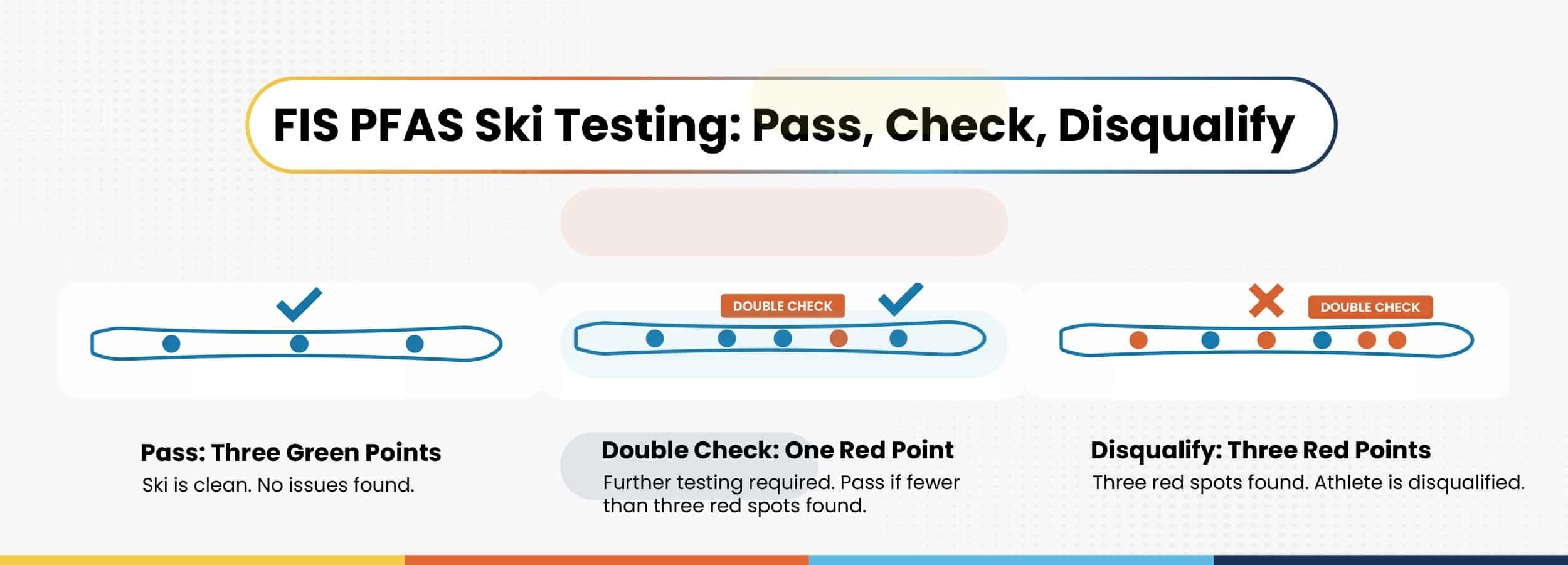
The ban has entered the spotlight after three athletes in the 2026 Winter Olympics, two from South Korea and one from Japan, were banned from competing when their skis and snowboards tested positive for traces of PFAS.
The Korean athletes, Lee Eui-jin and Han Da-som, were disqualified from the cross-country skiing event when fluorine was detected in the wax on their skis. The Korean Sport and Olympic Committee investigated the source of the wax and found that there had been an issue with the supplier, according to Korean media. The association issued a warning to the supplier in response to their findings.
The Japanese athlete, Masaki Shiba, took to Instagram to push back against the disqualification, stating that he had used the same wax brand in other events and never tested positive. The wax brand used by Masaki, Hayashi Wax, said in a statement that the wax used for the athlete's board that day was not theirs, and that a coach had mistakenly used the wrong wax.
PFAS in Korea and Japan
With athletes from South Korea and Japan in the spotlight, it is important to note that both countries also have their own regulations around PFAS. South Korea addresses PFAS as a persistent organic pollutant (POP) under the POPs Control Act, as well as through K-REACH, the Chemicals Control Act, and related administrative rules. The Ministry of Environment and the Ministry of Food and Drug Safety oversee PFAS management across their life cycle, from production to disposal.
Under the POPs framework, South Korea bans the manufacture, import, export, and use of perfluorooctanoic acid (PFOA), perfluorohexanesulfonic acid (PFHxS), and related compounds, with limited exemptions, and restricts perfluorooctane sulfonate (PFOS) to permitted uses consistent with the Stockholm Convention. While these laws do not specifically ban the use of PFAS in ski wax, the products must still follow the manufacturing laws that would effectively restrict the presence of listed PFAS above permitted thresholds.
Similarly, Japan has laws that cover ski wax under a wider framework rather than specifically targeting the product. Japan regulates PFAS primarily through its Chemical Substances Control Law (CSCL), which prohibits the manufacture and import of PFOS, PFOA, PFHxS, and related substances as Class I Specified Chemical Substances in line with the Stockholm Convention. Limited exemptions apply for research, certain legacy firefighting equipment, and narrowly defined “essential uses” with phaseout deadlines, but these remain subject to strict reporting, labeling, and technical standards. Notably, rather than adopting a single broad PFAS definition, Japan regulates specific substances and related compounds under different statutes, with scope varying depending on the law.
Ski Wax in the U.S.
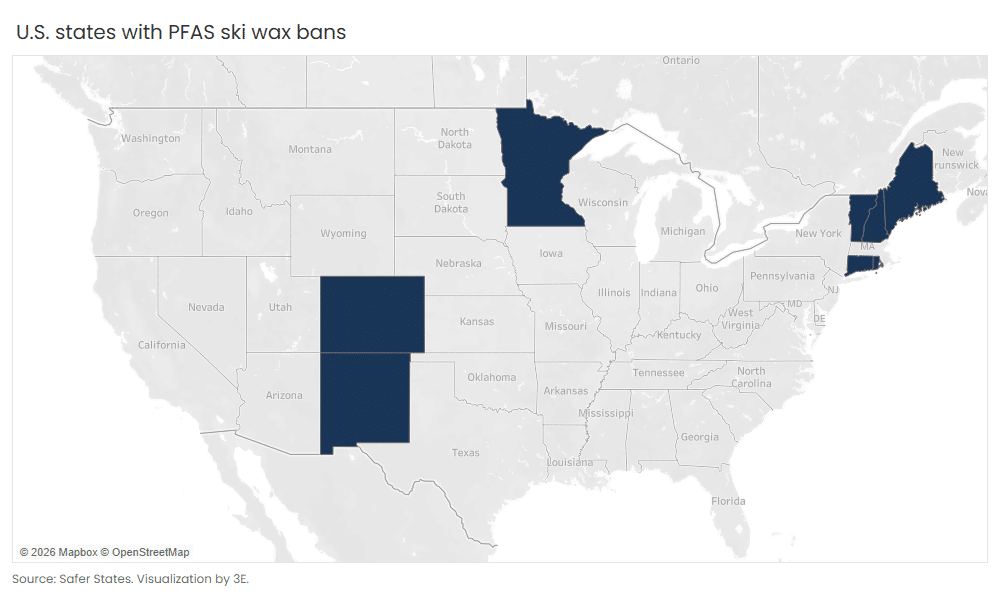
With the ski wax rules in the Olympics bringing PFAS in ski wax into the spotlight, it is important for manufacturers seeking to do business in the United States to understand the regulations that may impact their products. Unlike Japan and South Korea, there are several U.S. states that specifically ban ski wax with intentionally added PFAS. Colorado, Connecticut, Maine, Minnesota, New Hampshire, New Mexico, Rhode Island, and Vermont all have laws restricting or outright banning the sale of ski wax with PFAS within their borders. Below is a list of the key deadlines associated with these laws.
Vermont
- July 1, 2023 - Prohibition on products containing intentionally added PFAS went into effect under Act No. 36. Manufacturers, suppliers, and distributors may no longer manufacture, sell, offer for sale, or distribute ski wax products in the state if they contain intentionally added PFAS.
Minnesota
- January 1, 2025 - Prohibition on products containing intentionally added PFAS went into effect under Amara's Law. Manufacturers may no longer sell, offer for sale, or distribute ski wax products in the state if they contain intentionally added PFAS.
Colorado
- January 1, 2026 - Prohibition on products containing intentionally added PFAS went into effect under the PFAS Protection Act. Manufacturers may no longer sell or distribute ski wax products that contain intentionally added PFAS chemicals.
Maine
- January 1, 2026 - Prohibition on products containing intentionally added PFAS went into effect. Manufacturers may no longer sell or distribute ski wax products that contain intentionally added PFAS chemicals.
New Hampshire
- January 1, 2027 - Prohibition on products containing intentionally added PFAS will go into effect under HB 1649. Manufacturers may no longer sell or distribute ski wax products that contain intentionally added PFAS chemicals after amendments added in May 2025.
Rhode Island
- January 1, 2027 - Prohibition on products containing intentionally added PFAS will go into effect under the Consumer PFAS Ban Act of 2024. As of this date, no person may sell, offer for sale, or distribute ski wax products containing intentionally added PFAS in the state.
Connecticut
- July 1, 2026 - PFAS-containing ski wax sold into the state must include a clearly legible label that says, “Made with PFAS chemicals.”
- January 1, 2028 - Prohibition on products containing intentionally added PFAS will go into effect under Public Act No. 24-59. Manufacturers may no longer sell or distribute ski wax products that contain intentionally added PFAS chemicals after amendments added in May 2025.
New Mexico
- January 1, 2028 - Prohibition on products containing intentionally added PFAS will go into effect under the Per- & Polyfluoroalkyl Protection Act. Manufacturers may no longer sell or distribute ski wax products, directly or through intermediaries, that contain intentionally added PFAS.


Insights straight to your inbox
Sign Up NowReporter
Christopher Bornmann
Christopher Bornmann is the State Regulatory and Legal Action Reporter for 3E based in Washington, D.C. He covers the latest legal developments and updates in environmental, health, and safety (EHS) that impact the U.S. at the state level. He has experience working for the U.S. House of Representatives and national advocacy groups.

Related Resources
News
EU Omnibus Packages Part 5: Omnibus V – Simplifying EU Defense Regulation
News
EU Omnibus Packages Part 4: Omnibus IV — Product Regulation, Simplification, and Compliance
News
EU Omnibus Packages Part 3: Simplifying EU Agricultural Regulation
News
EU Omnibus Packages Part 2: Strengthening Investment Through Simplification