Related

Horizon Scanning: Moving From Restricted Lists to Regulatory Intelligence

Why product stewardship belongs in the business strategy conversation

What are product compliance data silos costing you?



In 2025, the European Union began to focus on regulatory simplification to enhance its competitiveness in a challenging global market. This series looks at the various Omnibus initiatives the EU Commission will be using throughout 2026 to reduce the regulatory burden on businesses while maintaining its high standards for sustainability, transparency, and innovation.
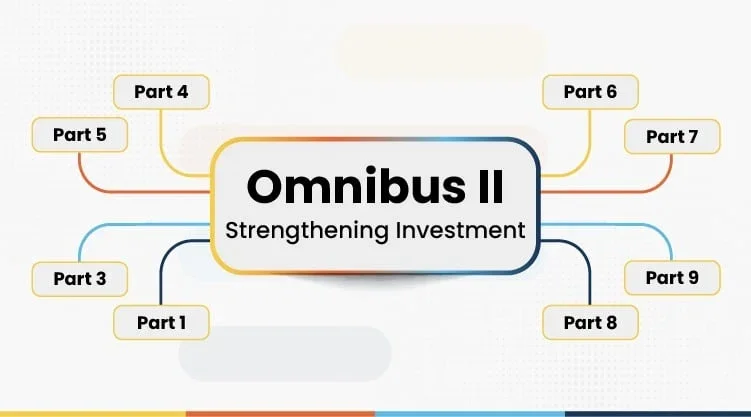
Omnibus II represents the second pillar of the European Commission's broader omnibus strategy aimed at enhancing the European Union's (EU) competitiveness by reducing regulatory complexity and improving the effectiveness of public investment instruments.
Unlike Omnibus I, which focuses primarily on sustainability reporting and due diligence obligations, Omnibus II is dedicated to the simplification, optimization, and strategic reinforcement of EU investment programs, with a particular emphasis on the InvestEU Programme to support sustainable innovation and investment in Europe.
At its core, Omnibus II seeks to maximize the impact of existing EU financial instruments rather than introduce new funding schemes. The initiative responds to long-standing concerns that EU investment programs, while substantial in volume, are often hindered by complex governance structures, fragmented implementation, and high administrative burdens for beneficiaries, intermediaries, and member states.
A central component of Omnibus II is the revision of the InvestEU Programme. The package strengthens the EU budgetary guarantee underpinning InvestEU and improves the use of returns and reflows from earlier investment programs. By doing so, Omnibus II aims to significantly increase the EU's capacity to mobilize additional public and private capital, particularly in strategically important areas such as clean technologies, industrial transformation, digital infrastructure, defense-related investments, and innovation.
Easing Regulatory Burden
Administrative simplification is another key pillar of Omnibus II. Application, due diligence, and reporting requirements are streamlined, especially for smaller transactions and financial intermediaries working with small- and medium-sized enterprises.
The package reduces duplicative checks, simplifies monitoring obligations, and introduces more proportionate reporting requirements, thereby lowering compliance costs and shortening project timelines. These changes are intended to make EU investment instruments more accessible, particularly for first-time applicants and smaller market participants.
In addition, Omnibus II enhances flexibility for member states by allowing greater discretion in the contribution and combination of national and EU funds. Clearer governance and risk-sharing arrangements further improve legal certainty for investors and encourage private-sector participation.
Overall, Omnibus II reflects a strategic shift in EU investment policy. Rather than expanding the regulatory framework, the initiative focuses on making existing tools work better, faster, and more efficiently.
By simplifying procedures, increasing flexibility, and strengthening leverage effects, Omnibus II aims to enhance the EU's ability to support large-scale investment, foster innovation, and reinforce economic resilience in an increasingly competitive global environment.

For more information, you can read the other articles in this series:
Material Compliance Specialist
Daniela Michaelis
Daniela Michaelis is a Material Compliance Specialist on 3E's Expert Service Team, and is based in Germany.

Related Resources
News
Horizon Scanning: Moving From Restricted Lists to Regulatory Intelligence
News
Why product stewardship belongs in the business strategy conversation
News
What are product compliance data silos costing you?