Related
EU Omnibus Packages Part 5: Omnibus V – Simplifying EU Defense Regulation
EU Omnibus Packages Part 4: Omnibus IV — Product Regulation, Simplification, and Compliance

Athletes Disqualified at 2026 Winter Olympics Over PFAS
EU Omnibus Packages Part 2: Strengthening Investment Through Simplification
In 2025, the European Union began to focus on regulatory simplification to enhance its competitiveness in a challenging global market. This series looks at the various Omnibus initiatives the EU Commission will be using throughout 2026 to reduce the regulatory burden on businesses while maintaining its high standards for sustainability, transparency, and innovation.
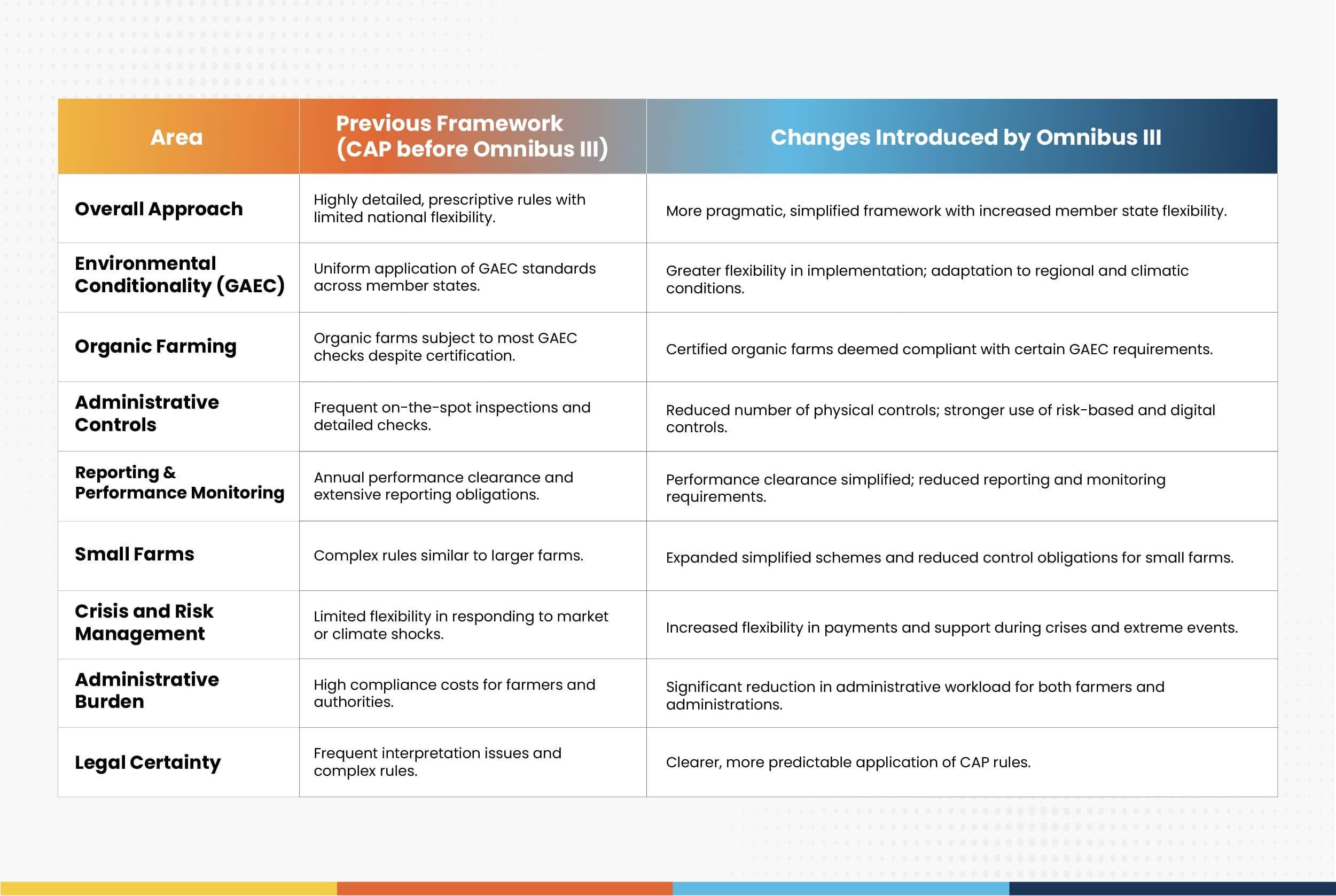
Omnibus III forms part of the European Commission's broader regulatory simplification agenda and specifically targets regulatory complexity within the Common Agricultural Policy (CAP). The initiative responds to persistent concerns from farmers, member states, and administrative authorities that the current CAP framework, particularly its environmental conditions and control mechanisms, has become excessively complex, rigid, and resource intensive. Omnibus III seeks to reduce administrative burdens while maintaining the core objectives of environmental protection, sustainable land management, and food security.
A central element of Omnibus III is the simplification of the rules that farmers must adhere to in order to receive funding from the European Union (EU), notably the Good Agricultural and Environmental Conditions (GAEC). The simplification package introduces greater flexibility for member states in how these standards are implemented and assessed, allowing national authorities to adapt requirements more closely to local agronomic, climatic, and structural conditions. Certified organic farms are, in many cases, deemed automatically compliant with certain GAEC standards, thereby eliminating duplicative controls and administrative procedures.
Omnibus III also significantly reduces the control and monitoring burden placed on farmers and administrations. The reform shifts further toward risk-based controls, increased use of digital tools and remote monitoring, and a reduction in the frequency of on-the-spot inspections. In addition, certain performance reporting and clearance mechanisms are streamlined or removed, reflecting a move away from process-driven compliance toward outcome-oriented oversight.
Special attention is given to small- and medium-sized farms, which often face disproportionate administrative pressure relative to their economic size. Omnibus III expands simplified payment schemes and introduces lighter control regimes for smaller beneficiaries, improving legal certainty and reducing compliance costs. At the same time, the package strengthens flexibility within CAP instruments to respond more effectively to exceptional circumstances, such as extreme weather events, market disruptions, or geopolitical shocks affecting agricultural production.
Importantly, Omnibus III does not represent a rollback of environmental or climate ambitions under CAP. Instead, it aims to improve the practical implementation and acceptance of sustainability requirements by making them clearer, more proportionate, and easier to administer. By reducing red tape and increasing national flexibility, the initiative seeks to reinforce the resilience, competitiveness, and long-term sustainability of the EU agricultural sector.
Overall, Omnibus III marks a shift toward a more pragmatic CAP implementation model. It balances environmental objectives with economic realities and administrative capacity, aiming to restore trust among farmers while ensuring that EU agricultural policy remains effective, credible, and future proof.
For more information, you can read the other articles in this series:


Insights straight to your inbox
Sign Up NowRelated Resources
News
EU Omnibus Packages Part 5: Omnibus V – Simplifying EU Defense Regulation
News
EU Omnibus Packages Part 4: Omnibus IV — Product Regulation, Simplification, and Compliance
News
Athletes Disqualified at 2026 Winter Olympics Over PFAS
News
EU Omnibus Packages Part 2: Strengthening Investment Through Simplification