Related
EU Omnibus Packages Part 5: Omnibus V – Simplifying EU Defense Regulation

Athletes Disqualified at 2026 Winter Olympics Over PFAS

EU Omnibus Packages Part 3: Simplifying EU Agricultural Regulation
EU Omnibus Packages Part 2: Strengthening Investment Through Simplification
In 2025, the European Union began to focus on regulatory simplification to enhance its competitiveness in a challenging global market. This series looks at the various Omnibus initiatives the EU Commission will be using throughout 2026 to reduce the regulatory burden on businesses while maintaining its high standards for sustainability, transparency, and innovation.
Omnibus IV represents a targeted step in the European Commission's (EC) broader simplification agenda, with a clear focus on product regulation and market access within the European Union's (EU) internal market. The initiative addresses structural regulatory challenges faced by growing companies and manufacturers, while supporting digitalization and legal certainty across harmonized product legislation. Its core pillars are the introduction of small mid-cap companies (SMCs), the simplification of product specifications, and the digitalization of the EU Declaration of Conformity.
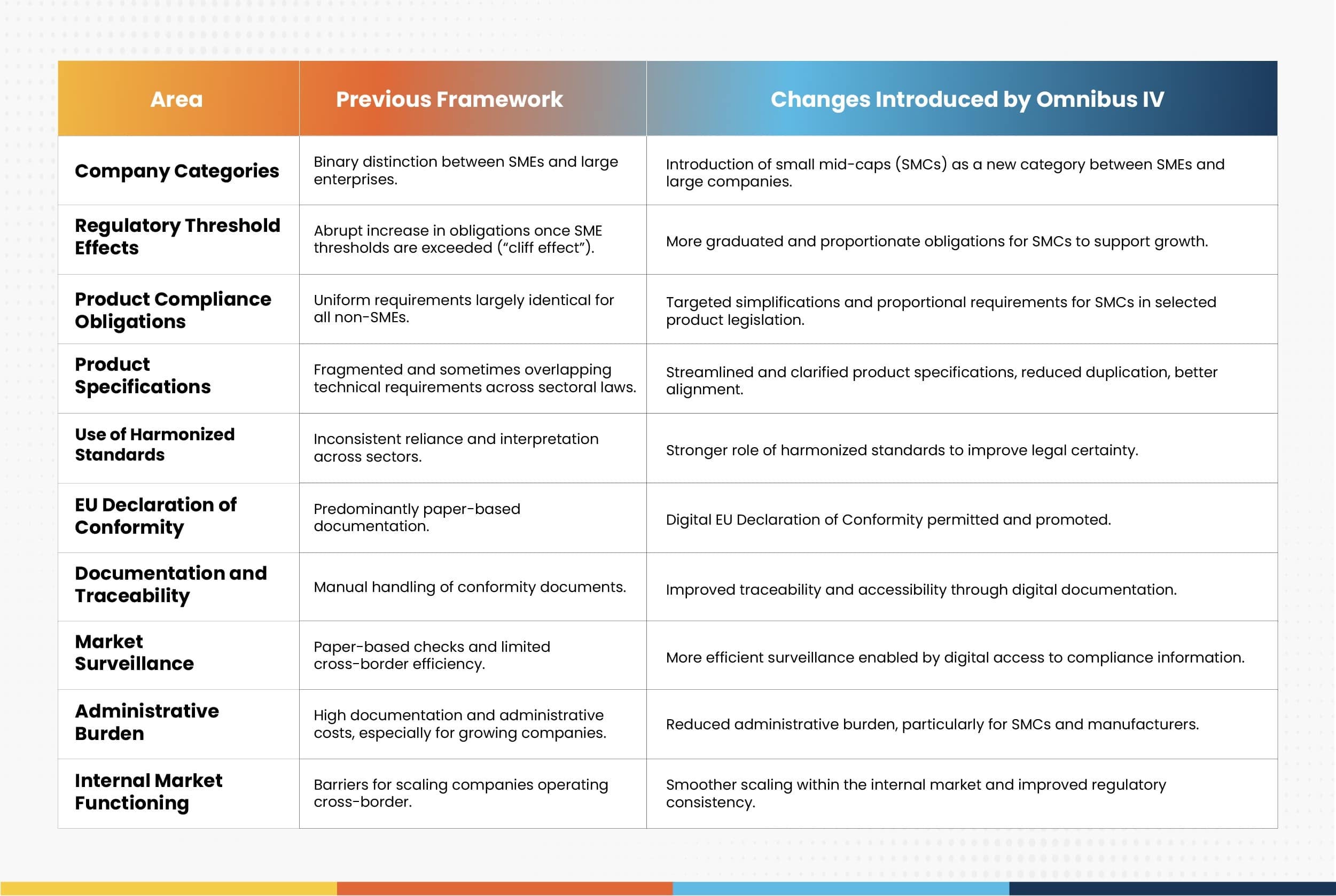
A central innovation of Omnibus IV is the formal recognition of small mid-caps as a distinct company category. These companies exceed thresholds for small and medium-sized enterprises (SMEs) but often lack the administrative capacity of large enterprises. Under the previous framework, crossing the SME threshold frequently triggered a sudden and disproportionate increase in regulatory obligations. Omnibus IV seeks to address this “cliff effect” with graduated and proportionate requirements for SMCs, particularly in areas such as conformity assessment, documentation, and market surveillance. This approach aims to support growth without undermining regulatory objectives.
In parallel, Omnibus IV introduces simplifications to product specifications across EU harmonized legislation. Technical requirements are to be clarified and streamlined, with a focus on reducing duplication and improving coherence between sectoral product laws. The initiative is designed to promote clearer structuring of essential requirements and a greater reliance on harmonized standards, thereby enhancing legal certainty for manufacturers, importers, and distributors operating across multiple member states.
A further key element is the digitalization of the EU Declaration of Conformity. Omnibus IV enables economic operators to make declarations available in digital form, replacing paper-based documentation. This shift supports more efficient market surveillance, improves traceability throughout supply chains, and significantly reduces administrative burden. It also aligns EU product compliance with broader digital transformation objectives and facilitates cross-border enforcement.
Overall, Omnibus IV strengthens the proportionality, efficiency, and modernization of EU product regulation. By combining targeted relief for growing companies with clearer technical rules and digital compliance tools, the initiative enhances the functioning of the internal market while maintaining high levels of product safety and regulatory oversight.
For more information, you can read the other articles in this series:


Insights straight to your inbox
Sign Up NowMaterial Compliance Specialist
Daniela Michaelis
Daniela Michaelis is a Material Compliance Specialist on 3E's Expert Service Team, and is based in Germany.

Related Resources
News
EU Omnibus Packages Part 5: Omnibus V – Simplifying EU Defense Regulation
News
Athletes Disqualified at 2026 Winter Olympics Over PFAS
News
EU Omnibus Packages Part 3: Simplifying EU Agricultural Regulation
News
EU Omnibus Packages Part 2: Strengthening Investment Through Simplification