Related

3E Appoints Matt Miller as Chief Financial Officer

The Trust Gap: Why AI Adoption Has Outpaced AI Readiness in EHS

A False Sense of Security? Navigating Canada’s Greenwashing Laws

AI for Regulatory Compliance: Can you stand behind that answer?
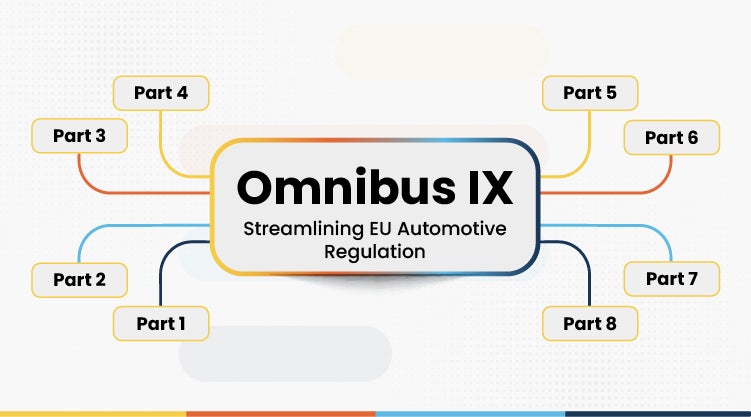
Omnibus IX represents a targeted initiative within the European Commission's broader simplification agenda, focusing on reducing regulatory complexity in the European Union (EU) automotive sector. The package addresses the cumulative impact of multiple EU regulations affecting vehicle manufacturing, type approval, emissions, digitalization, and supply chains. Its objective is to improve regulatory coherence, reduce administrative burden, and support the sector's transition to zero emissions and digitally connected mobility.
The EU automotive regulatory framework has evolved significantly in recent years, encompassing legislation such as the Type Approval Framework Regulation, carbon dioxide emission performance standards for vehicles, battery regulation, end-of-life vehicle requirements, and digital vehicle data provisions. While these instruments pursue complementary policy goals, their combined implementation has created overlapping compliance obligations, fragmented timelines, and high administrative costs for manufacturers and suppliers.
A key element of Omnibus IX is the streamlining of type approval and conformity procedures. The initiative promotes more efficient certification processes, including greater use of digital documentation and harmonized technical requirements across member states. This is expected to reduce time-to-market for new vehicle models and technologies.
In addition, Omnibus IX focuses on aligning reporting and compliance requirements across emissions, sustainability, and product safety legislation. By harmonizing data submission processes and timelines, the package aims to reduce duplication and improve consistency for manufacturers operating across multiple regulatory domains.
The initiative also introduces proportionate requirements for suppliers and small and medium enterprises (SMEs) within the automotive value chain, addressing the cascading compliance burden often experienced in complex supply networks. Simplified documentation and clearer obligations are intended to improve participation and reduce indirect regulatory pressure.
Digitalization plays a central role in Omnibus IX. The package supports the use of electronic conformity documentation, digital vehicle information systems, and interoperable data frameworks, enhancing traceability, regulatory oversight, and cross-border cooperation.
Importantly, Omnibus IX does not alter core environmental or safety objectives. Emission reduction targets, vehicle safety standards, and circular economy requirements remain unchanged. Instead, the focus is on improving implementation efficiency and regulatory usability.
Overall, Omnibus IX represents a pragmatic adjustment of EU automotive regulation. By reducing complexity, enhancing digitalization, and introducing more proportionate compliance mechanisms, the initiative aims to strengthen the global competitiveness of the European automotive industry while supporting its transition towards sustainable and innovative mobility solutions.

For more information, you can read the other articles in this series:
- EU Omnibus Packages Part 1: A New Phase of Regulatory Simplification
- EU Omnibus Packages Part 2: Strengthening Investment Through Simplification
- EU Omnibus Packages Part 3: Simplifying EU Agricultural Regulation
- EU Omnibus Packages Part 4: Omnibus IV - Product Regulation, Simplification, and Compliance
- EU Omnibus Packages Part 5: Omnibus V – Simplifying EU Defense Regulation
- EU Omnibus Packages Part 6: Omnibus VI – Simplified EU Chemical Regulation
- EU Omnibus Packages Part 7: Omnibus VII – Streamlining EU Digital Regulation
- EU Omnibus Packages Part 8: Omnibus VIII – Streamlining EU Environmental Regulation


Insights straight to your inbox
Sign Up NowMaterial Compliance Specialist
Daniela Michaelis
Daniela Michaelis is a Material Compliance Specialist on 3E's Expert Service Team, and is based in Germany.

Related Resources
News
3E Appoints Matt Miller as Chief Financial Officer
News
The Trust Gap: Why AI Adoption Has Outpaced AI Readiness in EHS
News
A False Sense of Security? Navigating Canada’s Greenwashing Laws
News
AI for Regulatory Compliance: Can you stand behind that answer?