Related


On GHG, U.S. EPA Rolls Back Reporting but Not Paperwork

What compliance innovators learned bringing AI into regulatory research

Beyond the Chemical List: Building Regulatory Readiness Into Product Data


In 2025, the European Union began to focus on regulatory simplification to enhance its competitiveness in a challenging global market. This series looks at the various Omnibus initiatives the EU Commission will be using throughout 2026 to reduce the regulatory burden on businesses while maintaining its high standards for sustainability, transparency, and innovation.
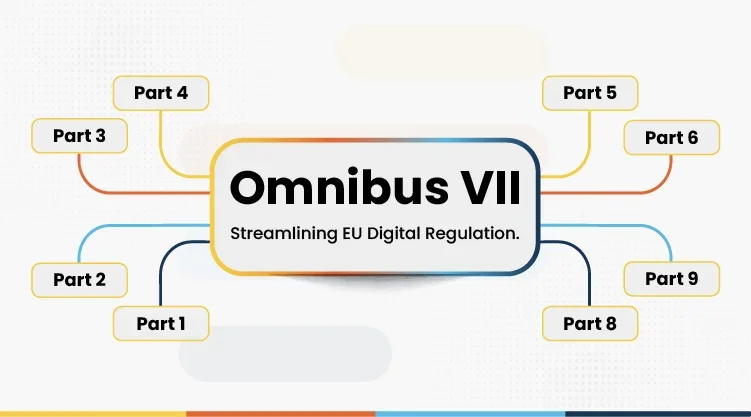
Omnibus VII forms part of the European Commission's broader simplification strategy and focuses on reducing regulatory fragmentation and administrative burden in the field of digital regulation. The initiative responds to increasing concerns that the cumulative impact of the European Union's (EU) digital legislative framework has created complexity for businesses.
In recent years, the EU has adopted an extensive body of digital legislation, including the Digital Services Act (DSA), the Digital Markets Act (DMA), the Data Act, the Data Governance Act, the AI Act, and the Cyber Resilience Act. While each instrument pursues specific policy objectives, their combined implementation has resulted in overlapping reporting duties, duplicative compliance processes, and inconsistent timelines. Omnibus VII seeks to address these challenges through horizontal alignment and procedural simplification, rather than substantive deregulation.
A key objective of Omnibus VII is the harmonization of compliance mechanisms across digital acts. This includes aligning reporting cycles, clarifying the interaction between supervisory authorities, and introducing more coherent risk-based compliance approaches. By reducing parallel notification and documentation requirements, the initiative aims to lower operational costs while maintaining high standards for consumer protection, cybersecurity, and data governance.
Another central element is the digitalization and standardization of administrative procedures. Omnibus VII promotes interoperable digital compliance tools, centralized reporting portals, and streamlined audit frameworks. The goal is to facilitate cross-border operations within the internal market and improve regulatory transparency.
For small- and medium-sized enterprises (SMEs) and growth-stage companies, the package introduces proportionate obligations and simplified documentation requirements, reducing the compliance “cliff effect” when scaling across member states. In addition, clearer guidance on data-sharing obligations and AI risk classification are expected to improve legal certainty for innovative technology providers.
Importantly, Omnibus VII does not weaken core digital policy objectives such as online safety, fair competition, or cybersecurity resilience. Instead, it aims to enhance regulatory coherence and implementation efficiency, ensuring that the EU digital framework remains both protective and innovation friendly.
Overall, Omnibus VII represents a strategic recalibration of EU digital governance. By reducing duplication, enhancing interoperability, and promoting proportionate compliance structures, the initiative seeks to strengthen Europe's digital competitiveness while safeguarding trust and fundamental rights in the digital environment.

For more information, you can read the other articles in this series:
- EU Omnibus Packages Part 1: A New Phase of Regulatory Simplification
- EU Omnibus Packages Part 2: Strengthening Investment Through Simplification
- EU Omnibus Packages Part 3: Simplifying EU Agricultural Regulation
- EU Omnibus Packages Part 4: Omnibus IV - Product Regulation, Simplification, and Compliance
- EU Omnibus Packages Part 5: Omnibus V – Simplifying EU Defense Regulation
- EU Omnibus Packages Part 6: Omnibus VI – Simplified EU Chemical Regulation
Material Compliance Specialist
Daniela Michaelis
Daniela Michaelis is a Material Compliance Specialist on 3E's Expert Service Team, and is based in Germany.

Related Resources
News
On GHG, U.S. EPA Rolls Back Reporting but Not Paperwork
News
What compliance innovators learned bringing AI into regulatory research
News
Beyond the Chemical List: Building Regulatory Readiness Into Product Data