
Related
EU Omnibus Packages Part 8: Omnibus VIII – Streamlining EU Environmental Regulation

3E Launches AI Platform and Comprehensive AI Solution Suite, Bringing Trusted Intelligence and Workflow Acceleration to Product Compliance

Changes Coming to EU Sustainable Finance Regulation

EU Omnibus Packages Part 7: Omnibus VII – Streamlining EU Digital Regulation
A compliance sweep of imported substances and products - the latest in a series of regular European Union (EU)-wide enforcement checks conducted since 2016 - revealed a surge in violations of REACH (Registration, Evaluation, Authorization, and Restriction of Chemicals) regulations in 2024 across a wide range of items in the EU, from industrial mixtures to consumer goods like jewelry and toys. The concerns of the REACH-En-Force-12 (REF-12) project, coordinated by the European Chemicals Agency (ECHA) and executed by the national member state enforcement authorities, were highlighted during ECHA's latest webinar and in the accompanying report recently released by the agency.
Henrik Hedlund, chair of ECHA's Forum for Exchange of Information on Enforcement and its REF-12 working group reported a striking disparity: 7% of registrations of imported substances on their own are non-compliant, compared with 32% of substances in mixtures - a distinction that appears to confuse or evade many importers.
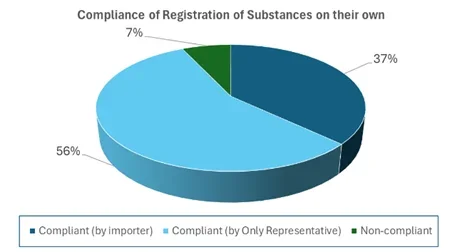
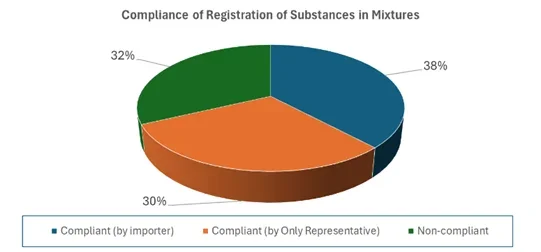
Source: REF-12 project. Visualization compiled by 3E. This visual and its contents are proprietary to 3E.
The report (sweep) - the latest in a series of regular EU-wide enforcement checks conducted since 2016 - identified a systemic problem in how companies interpret or implement REACH obligations for complex products. Compared with earlier projects, the latest findings show an increase in violations of certain requirements. In addition to ongoing concerns about nickel content in jewelry, the 2024 data reported a 25% non-compliance rate for asbestos, primarily in components of imported radio-controlled model cars. This represents a sharp rise from the 13.6% non-compliance rate in 2016. The increase indicates that the asbestos restriction, which fully entered into force in 2005, remains poorly understood by non-EU companies exporting articles to the EU.
The scale of the sweep was significant. It included more than 2,600 inspections across 29 countries. It looked at goods coming from 69 countries; nearly half of the items were articles (46%), followed by mixtures (28%), and substances (25%). China dominated as the primary country of origin, accounting for more than half the cases, followed by the United Kingdom (UK), Turkey, India, and the U.S.
The investigation verified product compliance with three core REACH pillars: registration, restrictions, and authorization. It also developed and applied the systematic use of customs data from import declarations to enhance the cooperation of national REACH enforcement bodies with customs authorities.
The enforcement effort reflects a broader shift in EU regulatory strategy: moving controls upstream to the border and integrating customs data into chemical compliance checks. In practice, this means the EU no longer relies solely on market surveillance but increasingly on intercepting non-compliant products before they enter circulation.
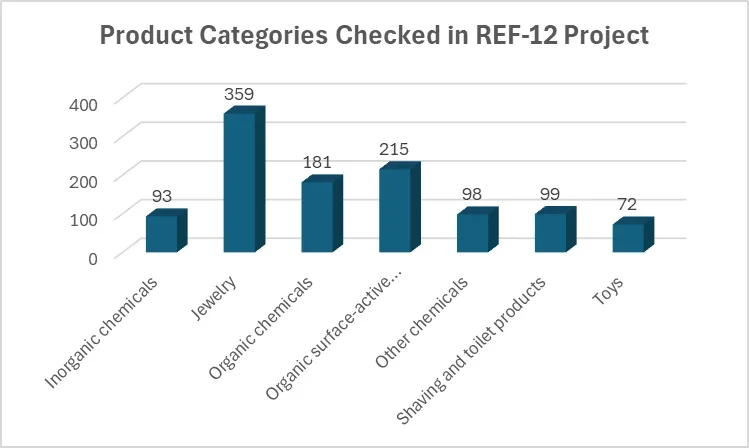
Source: REF-12 project. Visualization compiled by 3E. This visual and its contents are proprietary to 3E.
Registration Failures Expose Knowledge Gap
Geographically, compliance risks were uneven. The highest non-compliance rates of substance registrations were recorded for Turkey (20%), followed by India (17%), and then the UK (13%), but China accounted for the largest number of violations.
Evi Moutsipai, product policy and sustainability adviser for EuroCommerce - the principal European organization representing the retail and wholesale sector - pointed to another issue. For products originating from third countries, REACH requires the appointment of an EU-based only representative (OR). In her view, this requirement is often not met: Many products enter the market without such representation and violate REACH by direct product shipments.
Persistent Problems With Consumer Products
As for restrictions, Hedlund highlighted violations that reveal a more visible consumer risk.
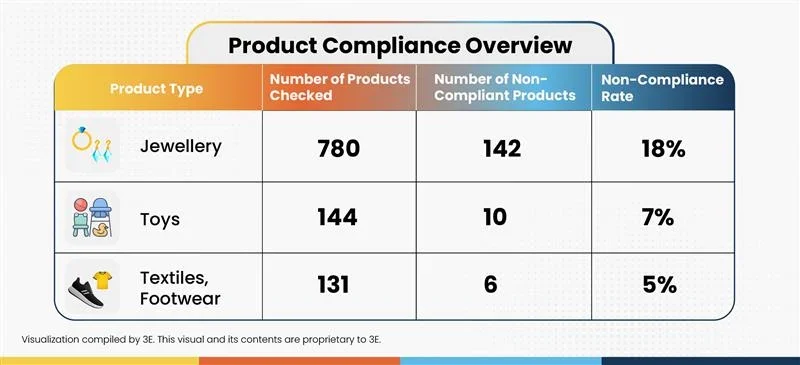
Across 1,329 inspections of restricted substances, 16% of products were non-compliant, particularly in consumer goods - especially jewelry, toys, and textiles.
Jewelry, as the most frequently checked product group, accounted for the largest share of inspections and violations with longstanding concerns about heavy metals such as lead, cadmium, and nickel:
- Nickel non-compliance reached 20%, significantly higher than in previous enforcement cycles.
- Cadmium and lead violations were lower but still persistent.
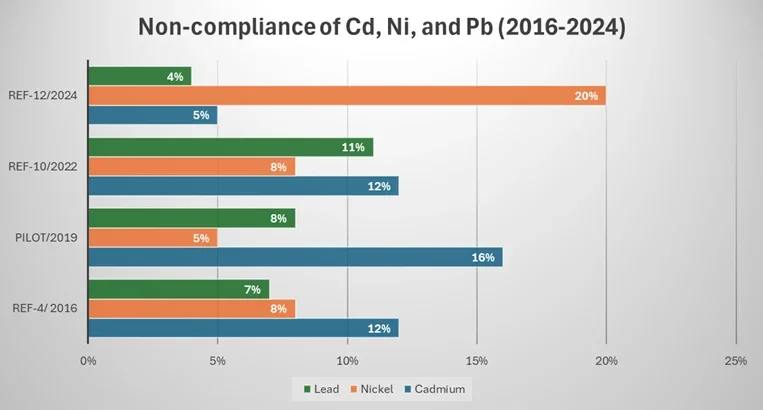
Source: REF-12 project. Visualization compiled by 3E. This visual and its contents are proprietary to 3E.
The trend suggests that despite years of enforcement, hazardous materials continue to appear in low-cost imported jewelry - often originating from large export markets such as China and India.
Mykyta Sobko, function policy officer for the European Consumer Organization (BEUC), drew attention to the parallel phenomenon of increasing e-commerce issues (see 3E article) that now are also raising concerns in the chemical sector. Participants of the webinar agreed that additional resources and efforts will need to be mobilized to address these issues.
Customs Becomes Front Line
One of the key topics that drew broad support at the webinar and in the report was the growing role of customs authorities in chemical enforcement - a shift that reflects both necessity and opportunity.
More than half of inspections relied on customs data or cooperation models where customs flagged shipments for further review. The most common approach - used in 45% of cases - involved customs providing import data to enforcement authorities for risk-based targeting.
At the same time, nearly half of the checks were conducted before goods were released for free circulation, signaling a dual strategy combining border controls with post-market enforcement.
Miquel Angel Aguado Monsonet, from the European Commission's (EC) Directorate General Taxation and Customs Union, explained that this integration is critical. Under EU law, customs can suspend the release of goods suspected of non-compliance, effectively acting as a gatekeeper for chemical safety. Once flagged, national enforcement authorities (NEA) assess compliance and determine whether goods can enter the market.
|
Model of Cooperation |
Number of Inspections |
Rate of Overall Inspections |
Hit Accuracy |
|
|
1.a |
NEA assesses REACH compliance asked by Customs |
20 |
2% |
5% |
|
1.b |
NEA assesses REACH compliance identified by risk analysis |
87 |
7% |
0% |
|
1.c |
Customs directly checks REACH compliance |
23 |
2% |
0% |
|
1.d |
Joint Customs/NEA check |
63 |
5% |
14% |
|
2.a |
NEA requests data from Customs |
963 |
80% |
14% |
|
2.b |
Customs ad-hoc data to NEA |
55 |
5% |
9% |
The approach is proving effective - but not without challenges. Authorities cite difficulties in the following cases:
- Interpreting customs classification codes (TARIC) for complex products.
- Identifying substances within mixtures.
- Applying consistent risk profiles across member states.
In some cases, even basic compliance requirements - such as certification codes for hazardous substances - were missing or incorrectly used.
Authorization Checks: Limited but Revealing
While registration and restrictions dominated enforcement efforts, checks on substances requiring special authorization were limited only to 21 relevant cases.
Even within this small sample, however, issues emerged. About 19% of cases showed non-compliance with authorization requirements, rising to 29% when errors in customs declarations were included.
The relatively low number of cases reflects structural constraints. Many authorized substances are used in niche supply chains, and customs systems are not yet fully equipped to identify them - particularly when embedded in mixtures.
Still, regulators see this as an area of growing importance, especially as new substances are added to REACH's authorization list. Delays in updating customs codes can create enforcement blind spots, allowing non-compliant imports to slip through.
Recommendations for Stronger Coordination and Funding
To address the gaps identified by the report, ECHA is urging the EC to step up both policy coordination and financial support, including:
- Targeting high-risk imports in trade dialogues, particularly products with repeated violations such as jewelry.
- Funding advanced testing capabilities, including support for customs laboratories to handle complex chemical analyses.
- Improving customs data systems, including more detailed classification codes for mixtures and high-risk articles.
- Clarifying regulatory coding systems, such as TARIC certification codes, to reduce errors by importers and customs authorities.
The EC is also being asked to accelerate updates to regulatory databases to keep pace with newly restricted or authorized substances.
NEAs are encouraged to expand pre-release checks at the border, which are considered the most effective way to prevent non-compliant products from entering the market. Recommendations include:
- Increasing use of risk-based customs screening.
- Investing in training and analytical tools for customs officers.
- Strengthening cooperation between enforcement agencies and customs authorities.
There are also calls for greater awareness campaigns targeting importers, particularly for consumer products and mixtures, where compliance gaps are most pronounced.
For companies, the message is unambiguous: compliance responsibility lies squarely with importers.
ECHA advises firms to secure robust documentation - such as analytical test reports - before importing products and to seek regulatory guidance proactively. Failure to do so increasingly risks shipment delays, market access barriers and enforcement action.
Outlook: A Tougher Environment for Importers
For companies operating in global chemical and consumer goods supply chains, the message is clear: EU enforcement is tightening, and compliance expectations are rising.
Importers can no longer assume that regulatory gaps or enforcement delays will allow non-compliant products to enter the market. With customs now acting as a frontline control point, non-compliance increasingly means blocked shipments, destroyed goods, or reputational risk.
At the same time, the burden of compliance is shifting upstream toward exporters and manufacturers outside the EU, who must navigate complex regulatory requirements or risk losing access to one of the world's largest markets.
As the EU refines its enforcement model, the balance between trade facilitation and regulatory control is becoming more explicit. For regulators, the challenge is to close remaining gaps without slowing legitimate trade. For industry, the challenge is to keep up.
In Europe's chemicals regime, the gate is still open but it is being watched more closely than ever.


Insights straight to your inbox
Sign Up NowEU Senior Regulatory Advisor
István Murányi
István Murányi is EU Senior Regulatory Advisor, 3E. Utilizing his 30 years of European and international experience in industrial communication, compliance, and training for regulatory, safety, and risk assessment in the cosmetic, home care, and chemical industries, he contributes Expert Analysis and regulatory-focused articles to 3E News.

Related Resources
News
EU Omnibus Packages Part 8: Omnibus VIII – Streamlining EU Environmental Regulation
News
3E Launches AI Platform and Comprehensive AI Solution Suite, Bringing Trusted Intelligence and Workflow Acceleration to Product Compliance
News
Changes Coming to EU Sustainable Finance Regulation
News
EU Omnibus Packages Part 7: Omnibus VII – Streamlining EU Digital Regulation