
Related

On GHG, U.S. EPA Rolls Back Reporting but Not Paperwork

What compliance innovators learned bringing AI into regulatory research

Beyond the Chemical List: Building Regulatory Readiness Into Product Data

Consumers, Industry, and Researchers Agree: TSCA Needs Reform


Editor's Note: 3E is expanding news coverage to provide customers with insights into topics that enable a safer, more sustainable world by protecting people, safeguarding products, and helping businesses grow. Conference Chatter articles, produced by reporters, feature insights from subject matter experts and influencers and substantive discussions of emerging trends and developments with industry leaders and professionals.
The U.S. chemical regulatory landscape is becoming increasingly complex. Several agencies are implementing new frameworks and programs that will require a combination of more transparency from regulators and more robust data reporting from companies, experts said.
American Chemistry Council (ACC) President Chris Jahn told attendees of the industry group's GlobalChem conference 26 March 2024 in Washington that chemical manufacturers are seeking additional regulatory clarity amid “fundamental concerns about the direction we're headed in.”
In his introductory remarks, Jahn added he has reached out to the Biden Administration to express interest in working with the U.S. Environmental Protection Agency (EPA) and others to shape policy.
“We're open to smart regulation,” Jahn said. “Our door is open to collaboration.”
Be Proactive in Reporting
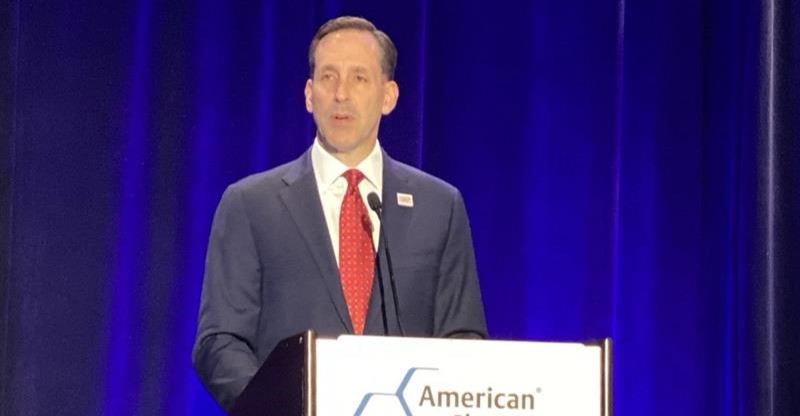
American Chemistry Council (ACC) President Chris addresses attendees of the industry group's GlobalChem conference 26 March 2024 in Washington. (Photo by Stefan Modrich/3E)
In December 2023, EPA initiated the process of prioritizing five chemicals as candidates for high-priority designation and subsequent risk evaluation:
- Vinyl Chloride
- Acetaldehyde
- Acrylonitrile
- Benzenamine
- 4,4'-Methylene bis(2-chloroaniline)
Mark Hartman, EPA's deputy director of Office of Pollution Prevention and Toxics (OPPT) said the agency encourages companies to be proactive in the reporting process, particularly with chemical prioritization under the Toxic Substances Control Act (TSCA).
“I have yet to see a situation where real-world information provided by stakeholders was not used for a more refined risk assessment,” Hartman said.
Companies across the value chain are beginning to understand the significance of being more attuned to chemical management issues, but there remains a need to educate companies about the scope of TSCA and reporting requirements, said Judah Prero, an attorney at Arnold & Porter.
“It's better to be forward thinking and work with EPA,” Prero said. “I'm a big proponent of engagement with the agency.”
Risk Evaluation Cannot Be Rushed
Both regulators and industry stakeholders agree that the timeframe for risk evaluation cannot be rushed. Jeff Morris, director of the Existing Chemicals Risk Assessment Division (ECRAD) within OPPT, acknowledged that the 3-3.5 year publication deadline for final risk evaluations of chemicals identified as a high priority for risk evaluation was designed with safety in mind.
“We need to approach this recognizing that there needs to be an orderly ramp down and an orderly ramp up,” said Patricia Underwood, the Department of Defense (DoD)'s executive director for chemical risk management.
Morris said EPA plans to account for potential uncertainty by being thorough and comprehensive, while also being efficient in their evaluations of chemicals with multiple uses.
“When we look at chemicals with many conditions of use, if we can find ways to develop scenarios that cover multiple conditions of use, we will be able to focus these protections where we need to,” Morris said. “We can scope best when we understand what the universe of potential uses for a chemical is”.
Related Resources
News
On GHG, U.S. EPA Rolls Back Reporting but Not Paperwork
News
What compliance innovators learned bringing AI into regulatory research
News
Beyond the Chemical List: Building Regulatory Readiness Into Product Data
News
Consumers, Industry, and Researchers Agree: TSCA Needs Reform